




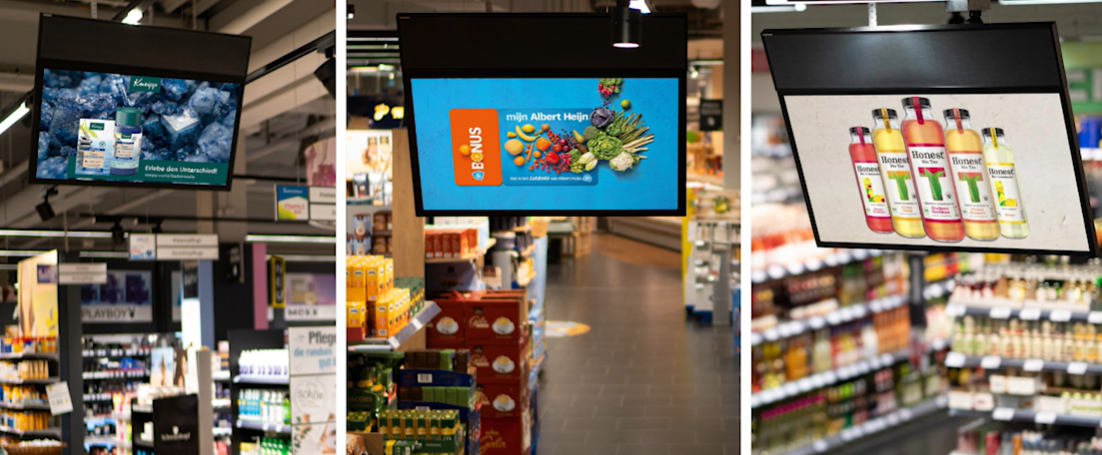


The billion-dollar question about in-store digital media—“Does it work?”—has gotten a resounding, research-based answer: Yes. That answer came in June 2025, when the Journal of Marketing published the findings of the largest-ever field-tested academic study of the impact of in-store digital advertising on shopper behavior.
On January 11, the study’s co-author, Dr. Dhruv Grewal, Toyota Chair in Commerce and Electronic Business at Babson College, presented his findings at the NRF’s What’s In Store for Retail Media Networks event in New York City. For the more than 550 retail media professionals who attended, the event produced by STRATACACHE proved to be one of the buzziest presentations of the day.
From the jump, Dhruv laid out the breadth of the study: Over four years, he and co-authors Dennis Herhausen and David de Jong at Vrije Universiteit Amsterdam tracked 237 ad campaigns in major European retailers’ stores, analyzing the receipts of more than 30 million customers.
But it wasn’t the study’s breadth but its depth that sparked the most chatter among NRF attendees. Not only did Dhruv and his fellow researchers find a direct causal link between in-store digital ads and sales lift—they unlocked invaluable insights into the neuroscience of precisely when, how and why in-store digital signage works.
Shopping Is a State of Mind
To understand why digital signage works, Dhruv detailed what’s happening in a shopper’s brain from the moment they walk through the door. Billions of bits of information hit them every second—merchandise, price tags, other shoppers, digital screens. Almost all of it, as much as 97%, is processed subconsciously.
“Most people don’t realize that we consciously only process a very, very small percentage of information,” Dhruv explained. “And most of our decisions are made subconsciously.”
Therein lies the power of an in-store digital ad. “Even when you’re not looking at it, your mind is already processing it just as you are walking by it,” he noted. “And that processing affects whether you decide to buy the item on the screen or not.” This is peripheral processing—the mental shortcut that prevents cognitive overload. In-store digital signage effectively hijacks this system.
During a fireside chat with Chris Riegel, STRATACACHE founder and CEO, Dhruv dove deeper into the neuroscience of in-store buying: “In psychology, some of the most famous processing models are called dual processing models. You either process information centrally—you look at and think through every attribute—or you take it in peripherally and internalize it: ‘Whoa, that’s a nice brand name’ or ‘That looks good.’”
The Impulse to Buy
The study found peripheral processing works differently depending on product type. Hedonic products—“emotional impulse” goods like snacks and cosmetics—deliver a stronger response to digital signage than utilitarian products.
“Anything that is emotional, our rational mind stops working,” Dhruv explained, citing a product like perfume. “Why should you pay $100 for this little perfume and $500 for that one? That one is called ‘Passion’—and that inspires a hedonic impulse decision.”
Digital signage becomes what Dhruv calls a “reason to buy instrument.” It creates needs shoppers didn’t know they had through 99% subconscious processing. “It really gives you a reason, it reinforces it, and suddenly in your mind you have a need for these products.”
Dhruv and his team tested specific shopping conditions to establish causality—isolating which factors actually drove sales lift from digital ad exposure. They tracked contextual variables including day of week, time of day, weather conditions, and store-crowding levels.
The study’s baseline finding was that in-store digital ads drive an 8.1% conversion rate lift on average. But under optimal conditions, that sales lift soars. Hedonic products showed 15.4% higher conversion, popular brands yield 16.7% higher conversions, while new items or flavors drive 24.7% higher conversion rates.
From Science to Sales
Dhruv reported that he and his colleagues found a direct causal link between human circadian rhythms and the efficacy of digital ads. Simply put, tired shoppers are more susceptible to digital signage influence. Later in the day (versus morning and midday), conversion rates jumped 22.1% higher. On weekends versus weekdays, sales of products advertised in-store were 11.7% higher.
“When people are tired, we make not necessarily the most rational choices,” Dhruv said, drawing a parallel to research on when telemarketing scams are most effective. “As we get tired, the body’s self-preservation mechanism reduces and we are not as alert to be able to look and say, ‘Are you trying to persuade me to do something that is not necessarily in my best interest?’”
This circadian effect—the way our cognitive defenses wane throughout the day—creates predictable windows of heightened suggestibility. Late-day shoppers, weekend shoppers, anyone cognitively depleted processes less rigorously and respond more to emotional cues.
Combined optimal conditions—hedonic product, evening timing, weekend, popular brand—could potentially push sales conversion to three times beyond the baseline. “If we get more sophisticated and we really start understanding it,” Dhruv said, “the 8% lift that I’m talking about will probably become 20 to 25% lifts.”
Consider an ad for sweets positioned on a screen near the checkout aisle: A chocolate bar pitched as an indulgent treat might work better for tired evening shoppers. The same product positioned as an energy booster might resonate with morning shoppers.
For the NRF attendees, the excitement of Dhruv’s research wasn’t just that it provided a scientific answer to the question of whether in-store media works. The chatter that his presentation inspired was about the strategic marketing possibilities his findings unlock: a neuroscience-based framework to shape in-store digital media campaigns for years to come.
Dhruv’s presentation and others from What’s in Store for Retail Media Networks are now available to watch at STRATACACHE.com.